Shop on Lazada
Gerber products
![Gerber Organic Oatmeal Baby Cereal 227G - From 6 Months [Lids may vary]](https://sg-test-11.slatic.net/p/3fb85d6155c54d3f1cad64e6bb90279b.jpg_200x200q80.jpg)
Gerber Organic Oatmeal Baby Cereal 227G - From 6 Months [Lids may vary]
$9.64$11.46
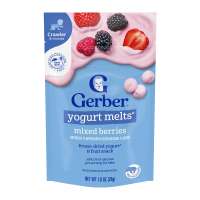
Gerber Mixed Berries Yogurt Melts 28G Baby Snack - From 8 Months
$8.45
Buy on Lazada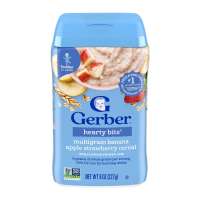
Gerber MultiGrain Banana Apple Strawberry Cereal 227G - From 12 Months
$11.46
Buy on Lazada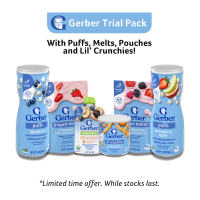
Gerber Exclusive Bundle – Full-Sized Packs (Worth $46.40 Limited Qty)
$28.59$46.40
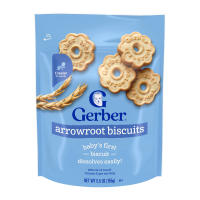
Gerber Arrowroot Biscuits Baby Snack 155G - From 10 Months
$8.45
Buy on Lazada![Gerber 1st Foods Prunes Puree Baby Food 80G - From 6 Months [Carton of 6]](https://sg-test-11.slatic.net/p/a9c2d888c5e27a7939c4b3af2246bdcf.jpg_200x200q80.jpg)
Gerber 1st Foods Prunes Puree Baby Food 80G - From 6 Months [Carton of 6]
$12.71
Buy on Lazada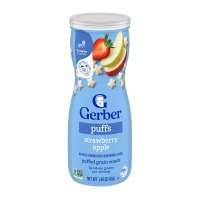
Gerber Strawberry Apple Puffs Baby Snack 42G - From 8 Months
$7.42
Buy on Lazada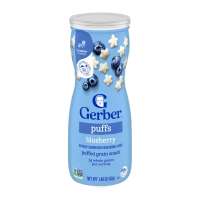
Gerber Blueberry Puffs Baby Snack 42G - From 8 Months
$7.42
Buy on LazadaAbout Gerber
Overview
Gerber is an American brand specialising in baby food and early-childhood nutrition. It is best known for its infant foods, cereals, snacks, and its iconic “Gerber Baby” logo. Founded in the late 1920s in Fremont, Michigan, Gerber grew from a small family canning operation into one of the most recognised names in infant nutrition. Since 2007, Gerber has been owned by Nestlé. 1
| Field | Information |
|---|---|
| Brand name | Gerber |
| Industry | Infant and early-childhood nutrition |
| Origin | United States |
| Founded | 1927–1928 |
| Founders | Daniel and Dorothy Gerber |
| Original location | Fremont, Michigan, USA |
| Parent company | Nestlé |
| Parent-company acquisition | 2007 |
| Best known for | Baby food, infant cereals, snacks and toddler nutrition |
| Icon | The “Gerber Baby” |
| Original Gerber Baby artist | Dorothy Hope Smith |
| Original Gerber Baby model | Ann Turner Cook |
| Main market historically | United States |
| International presence | Gerber products are sold in numerous markets |
Note: Gerber is sometimes confused with Gerber Childrenswear, which uses the Gerber name for baby clothing. The famous baby-food company discussed here is Gerber Products Company, now part of Nestlé. 2
History
Origins: 1927
The story of Gerber began with an ordinary parenting problem. In the summer of 1927, Dorothy Gerber was preparing solid food for her seven-month-old daughter, Sally. Following advice from her paediatrician, she was manually straining fruits and vegetables to make them suitable for the baby. The process was labour-intensive.
Her husband, Daniel “Dan” Gerber, was associated with the family’s Fremont Canning Company in Fremont, Michigan. He realised that the company’s commercial food-processing equipment could perform the same task much more efficiently. The company subsequently began producing strained foods suitable for babies. Workers at the plant asked for samples for their own children, helping demonstrate that there was a potential commercial market. 3
This small family innovation became the foundation of Gerber.
1928: The Gerber brand emerges
Gerber began commercially promoting baby food in 1928. Its early products included strained vegetables and other foods intended for infants. Nestlé’s historical material identifies Gerber as having been founded in 1928, while Gerber’s own history traces the originating family experiment to 1927. 4
The company’s early success was closely associated with a simple proposition: make nutritious food for babies more convenient for parents.
The Gerber Baby
Perhaps no element of Gerber is more recognisable than the Gerber Baby. In 1928, Gerber held a contest to find an illustration that could be used in advertising. Artist Dorothy Hope Smith submitted a simple charcoal sketch of a baby with large eyes, tousled hair and distinctive lips.
Although Smith offered to finish the drawing if she won, the judges preferred the simplicity of the original sketch and asked that it remain essentially unchanged. The illustration subsequently became the visual symbol of Gerber. 5
Who was the Gerber Baby?
For decades, the identity of the child was a popular mystery. People speculated that the baby might have grown up to be various celebrities. The actual model was Ann Turner Cook, who later became a mystery novelist and English teacher. Cook was identified publicly as the original Gerber Baby in 1978. 6
The illustration has consequently become one of the most enduring examples of a character being used as a corporate brand identity.
Evolution of the Brand
Gerber initially focused heavily on strained baby foods, but its business gradually expanded as scientific understanding of infant and toddler nutrition developed. Over the decades, the brand expanded into categories such as:
- Infant purees
- Fruits and vegetables
- Meat and combination foods
- Infant cereals
- Toddler foods
- Baby snacks
- Puffs and other finger foods
- Toddler beverages and nutrition products in selected markets
- Feeding-related products and resources
The exact product portfolio differs by country. Gerber’s modern positioning is broader than simply selling baby food. The company describes its approach as a stage-based nutrition journey, with products and guidance corresponding to children’s developmental stages. 6
Major Historical Milestones
1927 — Family experiment
Dorothy Gerber begins preparing strained foods for her daughter Sally, leading Daniel Gerber to recognise the potential of using the family canning operation to produce baby food.
1928 — Gerber Baby
Gerber conducts its advertising illustration contest, selecting Dorothy Hope Smith’s famous baby sketch.
1931 — Cereal
Nestlé India notes that Gerber introduced its first cereal in 1931, marking an early expansion beyond its original strained-food products. 7
1950 — Television advertising
Gerber’s first television commercial aired in 1950, reflecting the brand’s increasing importance in American consumer culture. 8
1978 — Gerber Baby identified
Ann Turner Cook was publicly revealed as the child depicted in the original Gerber Baby sketch. 9
2002 — FITS study
Gerber and Nestlé became associated with the Feeding Infants and Toddlers Study (FITS), a major research effort examining what infants and toddlers eat and how their dietary patterns develop. 10
2007 — Nestlé acquisition
Nestlé completed its acquisition of Gerber on August 31, 2007, effective September 1. Approximately 4,500 Gerber employees joined the Nestlé Group. 11
2011 — Gerber Generation Photo Search
Gerber began its Gerber Generation Photo Search, creating a modern counterpart to the historic Gerber Baby tradition. 12
2020 — First adopted spokesbaby
Magnolia Earl became Gerber’s first adopted spokesbaby after winning the 2020 photo search. 13
Gerber and Nestlé
One of the most important developments in Gerber’s corporate history was its acquisition by Nestlé. Nestlé completed the transaction in 2007, giving it a major position in the U.S. baby-food market. Nestlé said the acquisition strengthened its nutrition business and gave Gerber access to Nestlé’s worldwide research-and-development network. 14
Today, Gerber operates as part of Nestlé’s broader nutrition portfolio. This relationship is particularly interesting historically because both companies have roots in infant nutrition. Nestlé itself traces its origins to Henri Nestlé’s 1867 infant-food innovation, developed to help nourish an infant who could not breastfeed. Thus, Gerber’s history and Nestlé’s history eventually converged around a common field: early-life nutrition.
Products
Gerber’s product range varies substantially between countries, but the brand’s core portfolio generally revolves around infant and toddler nutrition.
Baby food
Gerber is particularly famous for packaged baby foods made from ingredients such as fruits, vegetables, grains, meat, and mixed meals. These products are typically formulated according to different stages of a child’s development.
Infant cereals
Cereal has been part of Gerber’s portfolio since the early 1930s. Modern versions may include grain-based products designed for infants beginning complementary feeding.
Snacks
As children transition from purees towards independent eating, Gerber offers products such as Puffs and other toddler-oriented snacks in various markets.
Toddler nutrition
Gerber has increasingly positioned itself around the transition from infancy into toddlerhood rather than limiting itself to traditional baby food. Its own materials describe the Gerber Nutrition Journey as extending from pregnancy-related support through the preschool years, although the available products differ by market.
Brand Identity
Gerber’s brand identity is unusually strong because its visual identity has remained connected to the same basic concept for almost a century. The brand is associated with:
- The Gerber Baby
- A friendly, child-centred visual style
- Emphasis on parents and caregivers
- Infant nutrition
- Simplicity and convenience
- Trust and familiarity
The Gerber Baby is particularly important because it is not simply a logo; it effectively functions as a symbol of infancy itself. The image has appeared on Gerber packaging and advertising for generations.
Marketing Strategy
Gerber’s marketing has historically revolved around a fundamental emotional proposition: parents want to give their children a healthy start in life. Instead of positioning itself simply as a food manufacturer, Gerber has built an identity around: baby → parent → nutrition → healthy development.
This explains why the Gerber Baby became so important. The image provides an instantly recognisable representation of the consumer the brand serves. Over time, Gerber’s marketing expanded beyond traditional advertising into parenting information, nutrition education, research, digital resources, baby photo searches, developmental-stage guidance, and parent communities.
The company launched its Parents’ Resource Center in 1986, demonstrating that parent support had become part of its brand proposition decades before the rise of modern digital parenting platforms.
Research and Nutrition
Modern Gerber places significant emphasis on nutrition science. A notable example is the Feeding Infants and Toddlers Study (FITS). The 2002 study examined the dietary behaviour of infants and toddlers and identified nutritional gaps and eating-pattern issues among young children. Gerber says the research has subsequently developed into a broader programme involving multiple studies and peer-reviewed publications.
Gerber also benefits from Nestlé’s global research infrastructure. Nestlé says its worldwide R&D network supports research in areas including safety and quality, nutrition and health, taste and texture, and convenience.
This represents an important change from Gerber’s early history: the company began with a practical household problem, whereas its modern identity is much more closely connected to food science, nutrition research and developmental stages.
Sustainability
Gerber has incorporated sustainability into its corporate positioning. Its stated initiatives have included:
Packaging
Gerber has worked towards increasing the recyclability or reusability of its packaging.
Agriculture
The company promotes responsible agricultural sourcing and has described its Clean Field Farming™ approach as part of its efforts to source ingredients responsibly.
Supply chain
Gerber has also stated goals concerning waste, carbon emissions and water use. These initiatives reflect a broader shift among food companies towards connecting children’s nutrition with environmental sustainability.
International Expansion
Although Gerber is strongly associated with the United States, the brand has expanded internationally. Nestlé describes Gerber as an international infant-nutrition brand, and its country-specific portfolios can differ considerably.
For example, Nestlé’s India business describes Gerber as serving consumers in more than 40 countries and offers products such as cereals and snacks tailored to the Indian market. 7
Gerber therefore operates with a combination of global brand identity + local product adaptation. The Gerber Baby provides continuity across markets, while product formulations and categories can be adjusted to local dietary practices, regulations and consumer preferences.
Gerber’s Position in Popular Culture
Gerber has achieved an unusual level of cultural recognition for a food company. Many food brands are recognised primarily by their name or packaging. Gerber is also recognised by a human face. The Gerber Baby has become so closely associated with babies that the illustration can function almost independently of the word “Gerber”.
This has given the brand several advantages:
- Instant recognition — the face is immediately associated with infants.
- Emotional association — it evokes childhood and parenthood rather than simply food.
- Generational continuity — parents may recognise the same symbol their own parents recognised.
- International adaptability — a baby’s face is more culturally neutral than many advertising characters.
- Brand differentiation — the illustration separates Gerber from generic baby-food packaging.
The company’s 1928 illustration is therefore one of the most successful examples of long-term visual branding in consumer packaged goods.
Gerber Today
Today, Gerber is primarily positioned as a baby and toddler nutrition brand within Nestlé. Its modern identity can be summarised as a heritage American baby-food brand that has evolved into a broader early-childhood nutrition business under Nestlé.
Its focus includes not only what babies eat but also how children progress through different stages of eating and development. Gerber describes its Nutrition Journey as a milestone-based approach designed to support children from early infancy through the preschool years. The brand’s almost century-long history gives it a significant heritage advantage, while Nestlé provides the corporate scale, research capabilities and international distribution infrastructure behind the modern business.
Ownership Structure
The corporate history can be simplified as follows:
Gerber family / Fremont Canning Company
↓
Gerber Products Company
↓
Major American baby-food brand
↓
Acquired by Nestlé in 2007
↓
Gerber as a Nestlé-owned brand
Nestlé completed the acquisition in September 2007 and described the deal as giving it the leading position in the U.S. baby-food market at the time. 2
What Makes Gerber Different?
Gerber’s competitive identity comes from the combination of several factors:
Heritage
Nearly a century of association with infant feeding gives Gerber enormous historical recognition.
The Gerber Baby
Few food companies possess a visual trademark as strongly associated with their category.
Nutrition specialisation
Unlike general food companies, Gerber’s brand identity is specifically centred on babies and young children.
Parent trust
The brand has deliberately positioned itself as a source of not only food but also information and guidance for caregivers.
Nestlé resources
Since 2007, Gerber has been supported by Nestlé’s global R&D, manufacturing and distribution capabilities.
Global/local strategy
Gerber maintains a consistent international identity while adapting its product portfolio to individual markets.
Summary
Gerber is a historic American infant-nutrition brand founded in Michigan in the late 1920s, famous for its iconic Gerber Baby, and now owned by Nestlé, with a product portfolio centred on baby food, infant cereals, snacks and toddler nutrition.
Simple Timeline
- 1927 — Dorothy Gerber begins preparing strained food for her daughter Sally
- 1928 — Gerber baby-food business develops; famous baby illustration selected
- 1931 — Gerber cereal introduced
- 1950 — First Gerber television commercial
- 1978 — Ann Turner Cook revealed as the original Gerber Baby
- 1986 — Parents’ Resource Center launched
- 2002 — FITS nutrition study
- 2007 — Nestlé acquires Gerber
- 2011 — Gerber Generation Photo Search
- 2020 — Magnolia Earl becomes Gerber’s first adopted spokesbaby
- Today — Gerber operates as a major Nestlé-owned baby and toddler nutrition brand.
Gerber’s significance goes beyond being a baby-food manufacturer. Its real achievement is turning infant nutrition into a recognisable consumer brand. A family problem in 1927 led to a commercial food business; a simple 1928 charcoal drawing transformed that business into an instantly recognisable global brand; and the 2007 Nestlé acquisition connected that heritage brand to one of the world’s largest food and nutrition companies.
References
- Our History And Heritage | Gerber
- Nestlé completes its acquisition of Gerber | Nestlé Global
- About Us | Gerber Childrenswear
- About Gerber Medical Hub | Gerber Medical
- About Us and Our History | Gerber
- About Us and Our History | Gerber
- Nourishing INfancy: Discover Gerber By Nestlé | Nestlé IN
- Taking a Look at the History of Gerber | Nestlé USA
- Happy 85th Birthday Gerber! Let’s Celebrate! | Gerber
- Gerber Photo Search 2026
- Gerber’s 1st Ever Impact Report | Gerber
- Gerber’s 1st Ever Impact Report | Gerber
- About Us|Gerber
- About Us|Gerber