Shop on Lazada
Grohe products
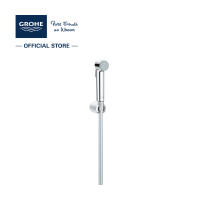
Grohe Tempesta-F Trigger Bidet Spray Set 27513001
$79.00$102.36
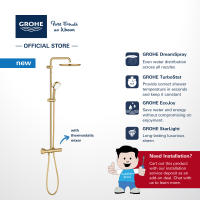
GROHE Tempesta Cosmopolitan 250 Shower System with Thermostatic Shower Mixer
$1,199.00$1,799.00
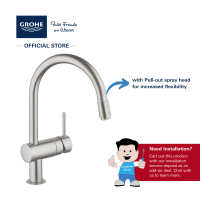
Grohe Minta OHM sink C-spout supersteel 32918DC0
$729.00
Buy on Lazada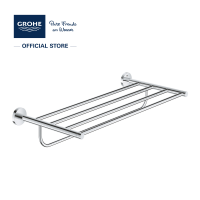
Grohe Essentials Multi-towel Rack 550mm 40800001
$279.00$379.00
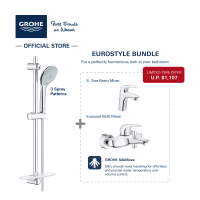
GROHE Eurostyle Shower Set & Basin Mixer Bundle (with S-size Tap)
$662.48$1,107.00
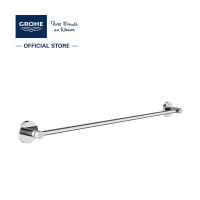
Grohe Essentials Towel Rail 600mm 40366001
$89.00$130.33
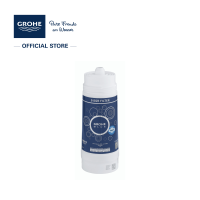
Grohe Blue filter S 40404001
$99.00$150.00
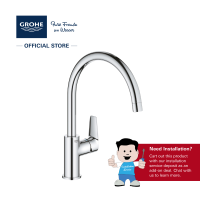
Grohe BauEdge OHM kitchen sink mixer C-spout 31233001
$219.00$269.00
About Grohe
Grohe is a German-origin global brand specialising in bathroom solutions, kitchen fittings, faucets, showers, sanitary products and water-related technologies. Founded in 1936 by Friedrich Grohe, the company has evolved from a domestic faucet manufacturer into one of the most recognised premium brands in the international bathroom and kitchen industry. Since 2014, Grohe has been part of LIXIL, the Japanese multinational corporation that also owns INAX and American Standard.1
The brand’s philosophy is encapsulated in the German phrase “Pure Freude an Wasser”, which translates to “Pure Joy of Water”. Grohe positions itself around four core values: Quality, Technology, Design and Sustainability.
Brand overview
| Item | Information |
|---|---|
| Brand | Grohe |
| Origin | Germany |
| Founded | 1936 |
| Founder | Friedrich Grohe |
| Industry | Bathroom, kitchen, sanitary and water technology |
| Parent company | LIXIL Corporation |
| Brand positioning | Premium / international |
| Headquarters | Düsseldorf, Germany |
| Main markets | Global |
| Core products | Faucets, showers, bathroom systems, kitchen fittings, sanitary products, water systems |
| Brand slogan | “Pure Freude an Wasser” |
| Core values | Quality, Technology, Design, Sustainability |
| Website | grohe.com |
Grohe describes its business as providing complete bathroom solutions and kitchen fittings rather than functioning solely as a faucet manufacturer.2
History
Foundation and early development
Grohe was established in Germany in 1936 by Friedrich Grohe following the acquisition of Berkenhoff & Paschedag, which laid the foundation for the brand.3 From its inception, the company focused heavily on water fittings and faucet technology, establishing a technical heritage that remains central to its identity.
Key milestones
In 1956, Grohe introduced a household bath faucet equipped with a thermostat, marking a significant advancement in shower and bath temperature control. The company regards this as the world’s first household bath faucet featuring integrated thermostatic technology.
The introduction of the single-lever mixer in 1968 helped establish the convenient faucet control mechanism that subsequently became an industry standard.
During the 1960s, Grohe began its international expansion, establishing operations and distribution networks in various markets, including Japan, which became a significant territory during this period.4 By the 1990s, the company had expanded its manufacturing footprint beyond Germany to include production facilities in countries such as Canada, Portugal and Thailand.5
In 2007, Grohe opened its corporate headquarters in Düsseldorf, reinforcing the city’s role as a central hub for its international operations.6
Relationship with LIXIL
A defining development in Grohe’s modern history is its integration into LIXIL. Formed in 2011 through the merger of several Japanese building-materials companies—including Tostem, INAX, Shin Nikkei, SUNWAVE and Toyo Exterior—LIXIL is a global manufacturer focused on water and housing products.
Grohe became an equity-method affiliated company of LIXIL in 2014 before transitioning to a consolidated subsidiary in 2015.7 This strategic relationship combines Grohe’s German engineering and design heritage with LIXIL’s Japanese technology, global resources and extensive portfolio of bathroom and housing brands. Today, LIXIL identifies Grohe as one of its major global product brands alongside INAX and American Standard.8
Product portfolio
While best known for faucets, Grohe offers a comprehensive range of water and bathroom products.
Faucets and mixers
Faucets remain the traditional core of the business. The range includes bathroom basin faucets, bidet faucets, bath faucets, shower mixers, thermostatic mixers, single-lever mixers, kitchen faucets, electronic faucets, wall-mounted faucets and floor-standing faucets. Grohe places significant emphasis on the engineering, internal mechanisms, durability, water control and finish quality of these products.
Showers
The shower portfolio encompasses hand showers, shower systems, rain showers, shower heads, thermostatic shower systems, concealed shower systems and digital shower technologies. These products are designed to function as integral components of the overall bathroom water experience rather than merely as plumbing fixtures.
Bathroom systems
Grohe has expanded from individual fittings towards complete bathroom solutions. This category includes faucets, showers, toilets, bidets, washbasins, accessories, flush systems, installation systems, bathroom furniture and complementary products. This shift supports the brand’s current positioning as a provider of complete bathroom solutions.2
Kitchen solutions
Grohe maintains a strong presence in the kitchen category with products including kitchen faucets, pull-out and pull-down faucets, filtered-water faucets, drinking-water systems and water-management technologies. Notably, the Grohe Blue system combines kitchen faucet functionality with water filtration and, depending on the configuration, chilled and sparkling drinking water, supporting efforts to reduce reliance on bottled water.9
Technology and innovation
Technology serves as a primary differentiator for Grohe, which has historically prioritised engineering and functional innovation over purely decorative considerations.
Thermostatic technology
Grohe has a long-standing association with thermostatic shower and bath controls designed to maintain consistent water temperatures, thereby enhancing both comfort and safety.
Water-saving technology
The EcoJoy technology is engineered to reduce water consumption while maintaining a satisfactory user experience.10
Smart water management
Grohe entered the connected-water category with the Grohe Sense ecosystem. Introduced in 2017, this includes water sensors and monitoring technologies, while Grohe Sense Guard was developed specifically to detect and respond to potential water damage and leaks.11
Water recycling
More recently, Grohe has explored water-recycling shower technology through Grohe Everstream. This concept is designed around recirculating shower water with the objective of substantially reducing both water and energy consumption.
Design philosophy
Design is integral to the Grohe identity. Rather than treating products as purely architectural or artistic objects, the company’s design philosophy seeks to combine form, ergonomics, engineering and user experience. A Grohe faucet is expected to be visually refined while offering precise water control, ease of cleaning, seamless integration into bathroom or kitchen environments and discreet incorporation of underlying technology.
Grohe states that its design activities are anchored in Germany and guided by its four brand pillars.12 The company has received numerous international accolades, citing more than 240 design and innovation awards over a ten-year period.13
Chrome finish heritage
Historically, Grohe has been closely associated with high-quality chrome finishes. For decades, the polished metallic aesthetic served as visual shorthand for German engineering and premium bathroom hardware. While the company now offers a wider variety of metallic and contemporary finishes, chrome remains a key element of the brand’s visual heritage and continues to be relevant in premium bathroom design where faucets serve as prominent visual features.
Brand positioning
Grohe operates in the premium and upper-premium segments of the bathroom market, positioned above mass-market plumbing brands. Its positioning rests on four foundations:
- German engineering: Products are described as being designed and engineered in Germany, reflecting the brand’s heritage and engineering culture.14
- Technology: Differentiation through water-control, thermostatic, digital and water-saving innovations.
- Design: Significant investment in industrial design and product aesthetics.
- Reliability: A focus on long-term quality rather than transient trends.
This combination makes Grohe particularly relevant to residential luxury properties, high-end apartments, hotels, resorts, commercial buildings, architect-designed homes and premium interior design projects. The company notes that its products have been specified in numerous high-profile projects globally.15
Brand pillars
The modern Grohe brand is defined by four explicit pillars:17
- Quality: Relates to engineering, materials, manufacturing precision, durability and tactile feel. Products are developed to high standards of fit, feel and finish.16
- Technology: Historically the strongest differentiator, encompassing thermostatic mixers, water-saving systems and connected-water products that make water easier and safer to control.
- Design: Connects technical performance with the visual language of the bathroom and kitchen.
- Sustainability: Increasingly central to the brand’s identity given its direct connection to water consumption.
Sustainability
Sustainability is a logical focus for a company whose products govern water usage. Grohe has addressed water-efficiency issues for more than 25 years, with sustainability formally identified as a strategic area of focus around 2000.18 Its strategy encompasses water conservation, energy efficiency, manufacturing processes, packaging, carbon emissions, product life cycles, responsible sourcing, circularity and social responsibility.
Key initiatives include:
- EcoJoy: Water-saving technology designed to reduce consumption without compromising the shower or faucet experience.10
- Less Plastic: An initiative aimed at eliminating unnecessary plastic from product packaging.
- Carbon-neutral production: Grohe achieved carbon-neutral production in 2020.14
- Cradle to Cradle: In 2021, Grohe launched its first products with Cradle to Cradle Certified status, reflecting a move towards circular product design and material selection.9
In February 2025, Grohe reported receiving an EcoVadis Gold Medal, placing it among the top 5% of more than 150,000 rated businesses.15
Major product families
Grohe has developed numerous recognisable product lines over the years, illustrating its evolution from a faucet specialist to a broader water-solutions company. Key examples include:
- Grohe Atrio: Premium architectural faucet collection
- Grohe Essence: Minimalist contemporary faucet collection
- Grohe Eurosmart: Widely used practical faucet range
- Grohe Eurocube: Geometric and contemporary design language
- Grohe Concetto: Modern everyday bathroom fittings
- Grohe Bau: Accessible and practical bathroom products
- Grohe Rainshower: Shower systems
- Grohe Grohtherm: Thermostatic shower technology
- Grohe Blue: Drinking-water and filtration systems
- Grohe Sense / Sense Guard: Connected water-management products
- Grohe Sensia Arena: Shower toilet
Grohe SPA
At the upper end of the portfolio is Grohe SPA, positioned as the premium and luxury expression of the brand. Rather than focusing solely on individual products, Grohe SPA is associated with highly customised bathroom environments and luxury water experiences tailored for luxury hotels, private residences, wellness centres and high-end architectural and interior design projects. Grohe describes Grohe SPA as a distinct premium sub-brand within its portfolio.
Professional market
Grohe serves not only homeowners but also professionals through dedicated programmes and services for architects, interior designers, contractors, plumbers, installers, developers, showrooms and hospitality professionals. The Grohe Professional offering is specifically intended to streamline installation and professional workflows.
This dual approach is strategically important because bathroom fittings are often selected long before the end consumer occupies a property. Decision-making typically involves multiple stakeholders—from architects and developers to contractors and installers—meaning Grohe operates simultaneously as a consumer brand and a professional specification brand.
Hospitality and architectural projects
Grohe maintains a strong presence in the hospitality and architectural sectors, with products specified in hotels, resorts, restaurants and other high-profile buildings. Published reference projects include the Mykonos Riviera Hotel & Spa, Under Restaurant in Norway and Pater Noster in Sweden. Such projects reinforce the brand’s premium image, as luxury hospitality venues select Grohe not only for its technical characteristics but also for the quality and design credibility it communicates.
Grohe in Japan
Japan holds particular significance in Grohe’s international history. Products were first introduced during the 1960s expansion, and Grohe Japan was formally established in 1991.4 The Japanese entity currently sells kitchen faucets, washbasin faucets, bathroom faucets, shower products, bathroom accessories and sanitary ware. Following the 2014 integration, Grohe Japan became part of the broader LIXIL group structure.8
Distinction from other LIXIL brands
It is important to note that Grohe and LIXIL are distinct entities. LIXIL Corporation operates multiple global product brands, including Grohe, INAX and American Standard.8 These brands coexist while addressing different consumer needs, markets and identities. Grohe is strongly associated with European and German design and premium water fittings, whereas INAX, for example, carries a distinct Japanese bathroom heritage.
Competitive proposition
Fundamentally, Grohe sells the experience and engineering of water. While a basic faucet answers the question of whether water is accessible, Grohe addresses a broader set of considerations: how water feels, the precision of control, temperature safety, consumption levels, aesthetic integration, long-term performance and overall bathroom cohesion. This distinguishes the brand’s identity from mere plumbing hardware.
Brand personality
Grohe’s brand personality can be characterised as German, precise, sophisticated, technical, restrained, premium and environmentally conscious. It is not positioned as an exuberant fashion brand; instead, its visual and communication language conveys precision, minimalism, engineering excellence, reliability, sophistication, modernity and water enjoyment. The German origin is therefore not merely historical but forms part of the brand’s contemporary positioning.
Brand slogan
The central brand expression, “Pure Freude an Wasser” (“Pure Joy of Water”), encapsulates Grohe’s aim to transform ordinary daily rituals—such as turning on a tap, showering or washing hands—into more enjoyable and refined experiences. Grohe states that this concept sits at the heart of its brand experience.
Timeline
| Year | Milestone |
|---|---|
| 1936 | Friedrich Grohe establishes the company in Germany |
| 1956 | Grohe introduces a household bath faucet with thermostatic technology |
| 1960s | International expansion begins; Grohe enters markets including Japan |
| 1968 | Single-lever mixer introduced |
| 1991 | Grohe Japan established |
| 1990s | International manufacturing footprint expands |
| 2007 | Corporate headquarters opens in Düsseldorf |
| 2014 | Grohe becomes part of the LIXIL group |
| 2017 | Grohe Sense and Sense Guard introduced |
| 2020 | Grohe achieves carbon-neutral production |
| 2021 | First Grohe products receive Cradle to Cradle certification |
| 2025 | Grohe reports EcoVadis Gold Medal, top 5% ranking |
References
- GROHE | About us: The GROHE company and its history | GROHE
- About Grohe
- HISTORY OF GROHE | GROHE
- About GROHE | GROHE
- Sustainability – About GROHE | GROHE
- FACTSHEET GROHE AGGROHE is a leading global bran
- GROHE Sustainability: Enjoy ecological water-saving technologies
- 会社概要 | GROHE
- GROHE Expands Cradle to Cradle Certified® Portfolio
- ブランド | GROHE
- About Grohe
- GROHE | À propos de nous : L’entreprise GROHE et son histoire | GROHE
- GROHE Sustainability Positioning Papers
- GROHE’s EPD & Cradle to Cradle: Driving Sustainable Solutions
- Reporting and Awards
- GROHE’s mission for a sustainable future
- Sustainability at GROHE
- Sustainability: Initiatives for highest levels of sustainability