Shop on Lazada
Heineken products
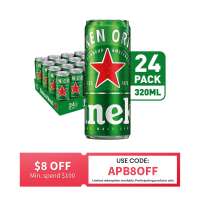
Heineken Lager Beer Can 24 X 320ML
$61.13$80.43
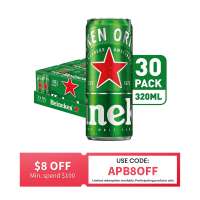
Heineken Lager Beer Can 30 X 320ML
$75.77$98.40
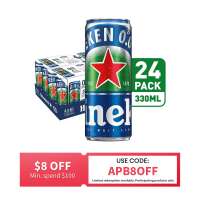
Heineken 0.0 % Zero Alcohol Beer Can 24 X 330ML
$26.64$48.44
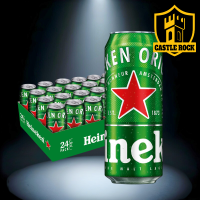
Heineken Lager Beer Can 24 X 490ml (BBD 09/2027)
$95.39$123.00
Heineken Lager Beer - 24 cans x 490ml (BCRS) (Bundle of 2) (BBD: 04/2027)
$192.00$193.20
Heineken Lager Beer - 24 cans x 490ml (BCRS) (BBD: 04/2027)
$95.98$96.60
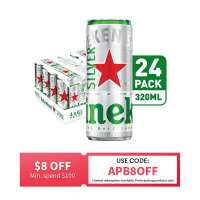
Heineken Silver Beer Can 24 X 320ML
$54.94$88.61
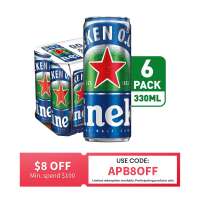
Heineken 0.0 % Zero Alcohol Beer Can 6 X 330ML
$7.14$12.11
About Heineken
Heineken is one of the world’s most widely recognised beer brands and serves as the flagship international lager of the Dutch brewing group Heineken N.V. The brand is distinguished by its green bottle, red five-pointed star, oval label and the distinctive “smiling e” in its wordmark. Originating in Amsterdam in the 19th century, Heineken has evolved from a local Dutch brewery into a global premium lager brand.1
Quick facts
| Field | Information |
|---|---|
| Brand | Heineken® |
| Industry | Brewing / alcoholic beverages |
| Product category | Premium lager beer |
| Origin | Amsterdam, Netherlands |
| Founded | 1864; the Heineken brewery was established in 1873 |
| Founder | Gerard Adriaan Heineken |
| Parent company | Heineken N.V. |
| Headquarters of parent | Amsterdam, Netherlands |
| Signature product | Heineken Original |
| Signature colours | Green, red, white |
| Iconic symbols | Red star, “smiling e”, green bottle |
| Key brewing identity | Heineken A-Yeast® |
| Positioning | International premium lager |
| Notable extension | Heineken 0.0 |
| Global character | Dutch heritage with worldwide distribution |
Overview
Heineken is a Dutch premium lager brand with roots in Amsterdam. While the name is commonly used to refer to the beer itself, it also denotes the broader brewing company Heineken N.V., which owns an extensive portfolio of beer and beverage brands.
The brand possesses a highly distinctive visual identity. Even without the Heineken name, consumers can often identify the product through its green packaging, red star and white lettering. The company describes the brand as being “born in Amsterdam, raised by the world.”2
The flagship product, Heineken Original, is a pale lager in the pilsner tradition. Its characteristic flavour is attributed to the proprietary Heineken A-Yeast®, which has formed part of the brand’s brewing identity since the 19th century.3
History
1864: The beginning
The brand’s history begins with Gerard Adriaan Heineken, who was born into an Amsterdam merchant family in 1841. In 1864, at the age of 22, he purchased the Amsterdam brewery De Hooiberg (“The Haystack”). Rather than competing primarily on price, Gerard focused on producing high-quality premium beer and adopted new brewing technologies. Historical records indicate that he introduced a quality-control laboratory at the brewery, reflecting his emphasis on consistency.4
1873: Heineken Brewery
In 1873, Gerard Heineken established his own brewery in central Amsterdam. This event is generally regarded as the founding of the Heineken brewery as the business developed under the Heineken name.5 From a relatively early stage, the brewery pursued international ambitions.
1875: First major international recognition
Heineken won a Medal d’Or at the International Maritime Exhibition in 1875. This award helped establish the reputation of the young Dutch brewery, and Heineken subsequently became a significant exporter, particularly to France.6
1889: Grand Prix in Paris
A further milestone occurred at the 1889 Paris Exposition, where Heineken’s pilsner was awarded the Grand Prix. The company states that this accolade remains represented on its packaging as part of the brand’s historical identity. Around this period, Heineken also began supplying beer to the restaurant at the Eiffel Tower.7
The Heineken family
For generations, the company remained closely associated with the Heineken family.
Gerard Heineken
As founder, Gerard established the company’s core philosophy: technological innovation, rigorous quality control and a focus on premium beer.
Henry Pierre Heineken
Representing the second generation, Henry Pierre Heineken became president of the Heineken brand in 1917. He oversaw expanded production and improved bottling technology, facilitating international growth while maintaining product quality.8
Alfred “Freddy” Heineken
Alfred Henry Heineken, commonly known as Freddy Heineken, was instrumental in the brand’s modern development. He was particularly influential in marketing and brand management, establishing Heineken’s advertising department and helping transform the beer from a domestic Dutch product into a globally recognisable lifestyle brand.9
Freddy is closely associated with several defining elements of the modern brand:
- The green brand colour
- The red star
- The Heineken banner
- Hop-vine imagery
- The distinctive “smiling e” letters
His approach emphasised selling the experience and enjoyment associated with the brand rather than merely promoting the beer itself.10
Heineken and the United States
One of the most notable episodes in Heineken’s international history occurred in 1933, as Prohibition in the United States neared its end. Anticipating repeal, Heineken dispatched a shipment of beer towards the US market. According to corporate history, the timing proved successful: Heineken became the first imported beer available in the US after Prohibition ended.11 This achievement became a key element of the brand’s international narrative and reinforced its reputation as a globally oriented brewer.
The Heineken beer
Heineken Original
The best-known product in the portfolio is Heineken Original. Positioned as a premium international lager, it offers a relatively light, crisp and refreshing character. The company describes the taste as balanced with subtle fruity notes, partly attributable to its A-Yeast®.12 In US product specifications, Heineken Original is listed at 5% ABV.13
Key characteristics
- Appearance: Golden/pale lager colour with a white head.
- Taste: Crisp and refreshing, with mild bitterness and subtle fruity characteristics.
- Style: International premium lager/pilsner tradition.
- Packaging: Most famously associated with the green glass bottle, though also sold in cans, draught formats and other packaging.
Heineken A-Yeast®
A central pillar of Heineken’s brewing identity is its use of Heineken A-Yeast®. Developed in the 19th century, this yeast strain contributes to the beer’s characteristic balance and subtle fruity notes.14 Strategically, it allows the brand to connect modern global production with its historical brewing heritage, ensuring that the beer retains a recognisable Heineken profile regardless of where it is brewed.
Brand identity
Heineken exemplifies long-term visual brand consistency.
The green bottle
The green bottle is one of the strongest visual associations with the brand, distinguishing Heineken from many competitors and becoming almost synonymous with its identity.
The red star
The five-pointed red star is perhaps Heineken’s most recognisable symbol after the name itself. Although older than modern advertising, its exact original meaning remains uncertain, with various explanations linking it to traditional European brewing symbolism.15 Following World War II, the star was temporarily changed to white with a red outline in some markets due to potential associations with communism. It gradually reverted, becoming fully red again in 1991.16
The “smiling e”
Another iconic element is the slightly tilted “e” in the Heineken wordmark. Freddy Heineken deliberately adjusted the typography to appear friendlier, making the corporate name feel less formal and more approachable.17
The Heineken label
The familiar Heineken label has evolved over more than a century, with historical versions dating back to at least 1883. The oval shape, green colour and central branding eventually became fundamental components of its international identity.18 The label also incorporates references to historical awards:
- Gold Medal — 1875
- Diplome d’Honneur — 1883
- Grand Prix — Paris, 1889
This represents a classic example of heritage branding, where historical achievements serve as permanent visual assets communicating quality and authenticity.19
Marketing strategy
Heineken’s success extends beyond the product itself. The company has historically invested heavily in global marketing, entertainment, sports and cultural sponsorships to associate the brand with social occasions and memorable experiences. Because functional attributes alone rarely differentiate beer products, Heineken emphasises a progression from beer to social experience, enjoyment and global lifestyle. Sponsorships are explicitly identified in company history as a primary method for engaging consumers and integrating the brand into their lifestyles.20
Sports and entertainment
Heineken is particularly renowned for associating itself with major international sporting and entertainment properties. Its sponsorship strategy reinforces attributes such as internationalism, sociability, premium positioning, excitement and shared experiences. By positioning itself as a global social brand rather than simply a Dutch beer, Heineken ensures its marketing resonates across diverse countries and cultures.
Heineken 0.0
A significant recent development was the introduction of Heineken 0.0. Launched in 2017, this alcohol-free beer is designed to offer the recognisable Heineken experience without alcohol, marking an important milestone in expanding the brand into new drinking occasions.21 This reflects a broader industry shift as consumers increasingly seek alternatives for moments when they prefer not to consume alcohol. Heineken has subsequently expanded the 0.0 concept with additional products and flavours.22
Heineken as a global company
It is necessary to distinguish between Heineken the brand and Heineken N.V. the company. Heineken® is the flagship beer brand, while Heineken N.V. is the multinational brewing group owning a much broader portfolio.
According to Heineken N.V.’s 2025 Annual Report, the company reported:
- €34.257 billion in revenue
- €28.753 billion in net revenue
- €3.406 billion in operating profit
- €1.885 billion in net profit
- Approximately 87,870 employees on an average FTE basis23
Specifically for the Heineken brand, volume grew by 2.7% in 2025, compared to 1.9% growth for global brands collectively.24 This illustrates the scale of the flagship brand within the wider corporation.
Sustainability and innovation
Sustainability has become increasingly integrated into Heineken’s corporate strategy. Innovation in this area is not entirely new; a historical example is the WOBO (World Bottle), developed in the 1960s. Designed so empty bottles could be reused as construction bricks, the concept did not achieve mainstream commercial success but demonstrates the company’s longstanding interest in packaging innovation.25 Today, sustainability is presented as integral to operations and long-term business strategy.26
Brand positioning
Heineken occupies a distinctive position in the international beer market, generally situated above mass-market value beers but below highly specialised craft or luxury offerings.
| Dimension | Heineken’s position |
|---|---|
| Price | Mid-to-premium |
| Market | Mass international |
| Perceived quality | Premium |
| Heritage | Very high |
| International recognition | Extremely high |
| Product specialisation | Relatively low |
| Brand emphasis | Lifestyle + quality |
| Geographic identity | Dutch |
| Global identity | Very strong |
Its core competitive advantage lies not in being exotic or experimental, but in recognisability, consistency, heritage, global availability and marketing.
Why the brand is so recognisable
Heineken’s branding success stems from a combination of remarkably consistent elements:
- Green: Immediate visual recognition
- Red star: Distinctive symbol
- White lettering: High contrast
- Smiling e: Friendliness
- Dutch heritage: Authenticity
- Premium lager: Accessible quality
- Global sponsorships: Cultural relevance
- Consistent packaging: Worldwide recognition
Consequently, the brand can often be identified by colour and shape alone.
Major milestones
Heineken timeline
- 1864: Gerard Heineken purchases De Hooiberg brewery in Amsterdam.27
- 1873: Heineken establishes its brewery under the family name.28
- 1875: Wins the Medal d’Or at the International Maritime Exhibition.29
- 1883: Historical origins of the recognisable Heineken label date to this period.30
- 1889: Heineken wins the Grand Prix at the Paris Exposition.31
- 1933: Enters the US market around the end of Prohibition, becoming the first imported beer available there after repeal.32
- 1950s: Freddy Heineken plays an increasingly important role in modernising the brand’s marketing and visual identity.33
- 1960s: The experimental WOBO bottle demonstrates interest in innovative packaging.34
- 1990s onwards: Global sponsorships become increasingly central to marketing strategy.35
- 2017: Heineken 0.0 launches, extending the brand into alcohol-free beer.
- 2025–2026: Continues expanding its alcohol-free and flavoured 0.0 portfolio while maintaining Heineken Original as its flagship product.
References
- Discover the history of Heineken® | Our Story | Heineken.com
- Heineken Original title
- Heineken® FAQ | Frequently asked questions | Heineken.com
- The Heineken Label :: Heineken Collection Foundation
- Discover the history of Heineken® | Our Story | Heineken.com
- 2025 Heineken NV Annual Report
- Heineken N.V. reports 2025 full year results
- Results, reports, webcasts & presentations | Heineken Holding N.V.
- Heineken N : 2025 Annual Report Report | MarketScreener
- Heineken N : 11 Feb 2026 – Heineken Holding N.V. 2025 Annual Report | MarketScreener
- Heineken N : 2025 Annual Report Report | MarketScreener UK
- HEINEKEN HOLDING N.V. REPORTS 2025 FULL YEAR RESULTS
- HEINEKEN N.V. REPORTS 2025 FULL YEAR RESULTS
- Heineken Holding N.V. – Earnings Release 2025 | FinancialFilings
- Heineken N.V. reports 2025 full year results | WebWire
- Heineken N.V. publishes combined Financial and Sustainability Annual Report 2024
- Heineken NV 2025 Annual Report with Sustainability Disclosures – Free PDF
- Heineken N.V. publishes combined financial and sustainability Annual Report 2023
- HEINEKEN launches 2030 Brew a Better World ambitions
- Discover the history of Heineken® | Our Story | Heineken.com
- The Heineken® Story
- Making of a Star | Campaigns | Heineken.com
- heineken.com
- Heineken® Beer | The Icon Heineken | Heineken.com
- Ontdek de historie van Heineken® | Ons verhaal | Heineken.com
- Details :: Heineken Collection Foundation
- Star stamp :: Heineken Collection Foundation
- Beer and Ciders| Heineken UK
- Key figures | Heineken Holding N.V.
- Heineken® Beer | The Icon Heineken | Heineken.com
- We are Heineken® | Our Story | Heineken.com
- We are Heineken® | Our Story | Heineken.com
- Notre histoire | Heineken France
- Istoria noastră – HEINEKEN
- Heineken Holding NV 2025 Annual Report with Sustainability Disclosures – Free PDF