Shop on Lazada
Jabadabado products
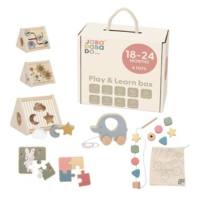
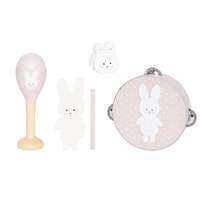
About Jabadabado
Jabadabado is a Swedish children’s design brand best known for its wooden toys, nursery décor, children’s furniture, baby products and playful accessories. Founded in Landskrona, Sweden, the brand combines Scandinavian design with bright colours, simple forms, imaginative themes and an emphasis on creative play. Its products are sold internationally, including across Europe, Australia and the Middle East.1
Quick facts
| Jabadabado | |
|---|---|
| Type | Swedish children’s design & toy brand |
| Origin | Landskrona, Sweden |
| Origins | 1993 |
| Brand established | 1999; registered as a brand in 2001 |
| Founders | Eva Eliasson and Calle Eliasson |
| Headquarters | Landskrona, Sweden |
| Main products | Wooden toys, baby products, children’s furniture, décor |
| Design identity | Scandinavian / Swedish, colourful, playful, functional |
| Current ownership | Profura, through Bare Collective |
| International reach | Europe, Australia, Middle East, and other global markets |
| Official website | jabadabado.se |
The dates associated with the brand can appear slightly confusing because 1993 marks the beginning of the founders’ toy-making business, while 1999 was when Eva and Calle committed fully to their own toy brand, and 2001 was when the Jabadabado name was registered as a trademark.1
History
The beginning: 1993
Jabadabado’s story began during Sweden’s economic difficulties in the early 1990s. Eva Eliasson, an interior designer, lost her job in 1993 following the financial crisis. Rather than abandoning design, she began making wooden toys in the basement of her home in Landskrona. One of her earliest creations was a wooden rocking horse made as a christening gift for a friend’s child.1
People who saw Eva’s toys began asking to buy them, and what had started as a hobby gradually became a business. Eva eventually joined forces with her husband, Calle Eliasson. In the early days, the couple personally designed and manufactured their toys, working from the first sketch through to painting and finishing. They subsequently opened a toy shop in Landskrona.1
From toy shop to brand
The couple initially expanded into distribution of other international toy and baby brands. However, they continued to have the ambition of creating a substantial brand of their own. In 1999, they stopped distributing other brands and concentrated on their own designs. This is the point Jabadabado identifies as the beginning of the brand in its modern form.1
The name Jabadabado was subsequently registered as a brand in 2001.1
Development of the brand
Jabadabado’s growth can roughly be divided into several stages:
1993–1999 — Handmade wooden toys
The company developed from Eva’s basement workshop and the couple’s small-scale toy business.
1999–2001 — Dedicated brand
The founders committed themselves to their own designs, with production expanding through selected manufacturing partners.1
2009 — Beyond toys
Jabadabado expanded beyond traditional toys into children’s-room décor and furniture.1
2011 — Design-led strategy
The company increasingly focused on products designed internally from concept to finished product.1
2012 onward — International expansion
Jabadabado expanded outside Sweden, first more extensively across Europe and subsequently into additional international markets.1
2021 — Bare Collective
Jabadabado became part of Bare Collective, a group focused on children’s and hygiene products.1
2025 — Profura
Profura acquired Bare Collective, thereby becoming the owner of the group containing Jabadabado. Profura describes Jabadabado as one of Bare Collective’s brands and lists the acquisition under its holdings.
As of 2026, the ownership structure can essentially be understood as:
Profura → Bare Collective → Jabadabado
Product range
Jabadabado has evolved considerably beyond its original wooden toys. Its current range broadly includes:
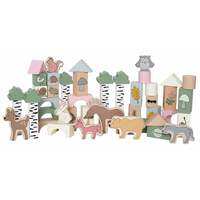
Wooden toys
This remains one of the brand’s defining categories. Products include:
- Building and stacking toys
- Vehicles
- Pretend-play toys
- Activity toys
- Puzzles and games
- Wooden animals
- Play sets
- Educational toys
Baby products
The brand also produces products aimed at babies and young children, including:
- Soft toys
- Comforters
- Baby rattles
- Blankets
- Baby gifts
- Pram/stroller toys
- Other early-childhood accessories
Children’s-room décor
Jabadabado has a strong nursery and children’s-interior component, including decorative pieces and accessories intended to make children’s rooms part of the play environment.
Children’s furniture and play equipment
The range has also included furniture and larger play-oriented products.
Birthday and celebration products
One particularly recognizable part of the Jabadabado universe is its birthday collection, including its traditional birthday trains and decorative pieces. The company presents birthday celebrations as an important part of its brand identity.1
Design philosophy
If there is one thing that distinguishes Jabadabado, it is the combination of Scandinavian aesthetics and deliberately playful children’s design. The company describes its design language as simple and stylish, while using distinctive colours and patterns. It places particular emphasis on colour, design, function and natural materials.1
The philosophy is essentially that design should make play more imaginative, not merely make a toy look attractive. Jabadabado says its products are intended to support children’s creativity, imagination, curiosity, learning, independent play, storytelling and exploration. Its current brand language summarizes the approach as “Designed to explore. Made to create. Loved in play.”1
The Scandinavian aesthetic
Jabadabado sits within the broader tradition of Scandinavian children’s design, but its appearance is generally more playful and colourful than the minimalist end of Scandinavian design. Typical characteristics include simple shapes, soft or contemporary colours, playful characters, functional construction and natural materials.
This gives the products a distinctive balance: they are intended to be children’s toys first, but also visually compatible with modern children’s bedrooms and family homes. That dual role—toy and interior object—is an important part of the brand.
Materials and sustainability
Jabadabado states that it works with natural and sustainable materials, particularly wood and cotton. Its current sustainability messaging also highlights FSC-certified wood, non-toxic paints and durable design.1
The sustainability philosophy is not simply about material selection. The company also emphasizes making products that can last and remain relevant to children over time. The brand’s sustainability proposition is built around several ideas:
- More natural materials
- Responsible material choices
- Product safety
- Durable construction
- Timeless rather than disposable design
- Toys that can be passed on or enjoyed by another child
The company describes this as “joyful responsibility.”1
Character universe
Jabadabado has developed recognizable recurring characters rather than treating every product as an isolated design. Two particularly important characters are Teddy and Bunny. They appear across different product categories—from soft toys and baby products to music sets, gift boxes and other collections. Jabadabado describes them as signature companions within its brand universe.1
This is strategically important because recurring characters create brand continuity. A child may encounter Bunny as a baby and later see the same character on a toy or birthday product.
Jaba World
A newer expression of the brand is Jaba World, a themed play universe built around wooden roads, vehicles, animals and imaginative adventures. Rather than selling only individual toys, Jabadabado increasingly creates small interconnected worlds in which children can combine products and construct their own stories.1
For example, a child can use vehicles, roads, animals and themed environments together for open-ended pretend play. This reflects the company’s broader shift from simply producing objects for children toward creating play ecosystems.
Brand positioning
Jabadabado occupies a position between several categories:
- Toy brand: Its heritage is strongly rooted in wooden toys and children’s play.
- Children’s lifestyle brand: Its products extend into décor, furniture, baby goods and celebrations.
- Scandinavian design brand: Its visual language is strongly associated with Swedish and Scandinavian design.
- Gift brand: Many of its products—especially baby products, birthday trains and decorative toys—are designed to work well as gifts.
This makes Jabadabado somewhat different from mass-market toy manufacturers whose primary focus is entertainment based around licensed characters.
Comparison with conventional toy brands
A useful way to understand the brand is to compare its priorities against traditional mass-market offerings:
| Traditional mass-market toy brand | Jabadabado |
|---|---|
| Entertainment-led | Design + play-led |
| Often plastic-heavy | Strong wooden-toy heritage |
| Character/licensing focused | Own characters and original concepts |
| Toy as standalone object | Toy as part of a play environment |
| Strong emphasis on trends | Timeless Scandinavian aesthetic |
| Primarily toy category | Toys + baby + décor + furniture |
This is a broad positioning comparison rather than a strict rule for every product.
Manufacturing
An important distinction is that “Swedish design” does not necessarily mean “manufactured in Sweden.” Jabadabado states that its products are designed in Sweden, while production is carried out with selected manufacturing partners. The company has described its production network as having developed significantly from the handmade origins of the business.1
This is typical of many contemporary Scandinavian design companies: the creative and design identity remains Swedish, while manufacturing can be international.
Company and headquarters
Jabadabado operates as Jabadabado AB, with its address in Landskrona, Sweden. The company currently lists its headquarters and contact address at Varggatan 10 in Landskrona.1
Its current company profile describes the business as a Swedish design company specializing in toys, baby products, children’s interiors and design. The company’s LinkedIn profile currently places it in the 11–50 employee range.2
Ownership
The ownership history is notable because it has changed relatively recently.
Until 2021
Jabadabado remained a family-owned business associated with its founders.
2021
It became part of Bare Collective.1
2025
Profura Industri AB acquired Bare Collective, bringing brands including Jabadabado, Leander and Esska into the Profura group. Profura describes the acquisition as part of its strategy of long-term ownership.
Profura’s current portfolio lists Jabadabado as a children’s and baby-products business and gives its acquisition year as 2024; this likely reflects the underlying transaction timing, while the public announcement of Profura’s acquisition of Bare Collective was made in January 2025.
International presence
Although Jabadabado is distinctly Swedish in its identity, it is not primarily a domestic Swedish brand. The company says its products are sold throughout Europe, Australia and the Middle East. Profura states that the wider Bare Collective group sells its products across more than 40 markets worldwide.
Thus, Jabadabado can be characterized as a Swedish-origin international children’s lifestyle brand.
Distinctive characteristics
The most interesting aspect of Jabadabado is the consistency of the world surrounding the products. The brand has gradually built a recognizable visual and emotional language: Swedish origin, Scandinavian design, natural materials, playful colours, recurring characters, imaginative play, children’s interiors and family traditions.
Its original rocking horse is therefore more than just the first product in the company’s history: it represents the brand’s basic idea that good children’s products can combine craftsmanship, design, imagination and emotional value. The company still refers to that first rocking horse as a reminder of its origins.1
Timeline at a glance
- 1993 — Eva Eliasson begins designing wooden toys in Landskrona.
- 1995 — Early collections reach Swedish toy stores.
- 1999 — Eva and Calle focus fully on their own toy brand and expand production.
- 2001 — Jabadabado is registered as a brand.
- 2009 — Children’s décor and furniture are introduced.
- 2011 — Greater emphasis on internally developed designs.
- 2012 — International expansion accelerates.
- 2019 — Brand reaches additional global markets.
- 2021 — Jabadabado becomes part of Bare Collective.
- 2023 — Major growth milestone for the brand.
- 2025 — Profura becomes the owner of Bare Collective.
- 2026 — Jabadabado continues as a Swedish-designed international children’s brand.1
Summary
Jabadabado is best understood not simply as a wooden-toy company, but as a Swedish children’s design and lifestyle brand. Its roots are in handmade wooden toys, but its modern identity encompasses toys, baby products, children’s interiors, furniture, birthday traditions and interconnected imaginative-play worlds. The common thread is playful Scandinavian design with an emphasis on creativity, functionality, quality and longevity.1