Shop on Lazada
Scanpan products
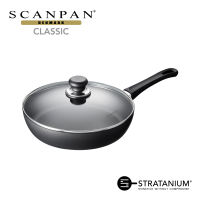
SCANPAN Classic 28cm/3L Covered Sauté Pan
$169.00$369.00
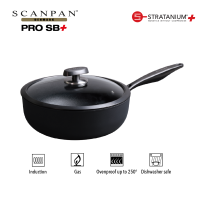
SCANPAN Pro SB+ 26cm/3.7L Covered Deep Sauté Pan
$319.00$579.00
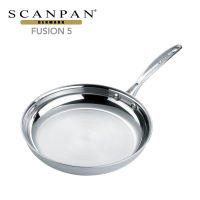
SCANPAN Fusion 5 28cm Fry Pan
$84.90$179.00
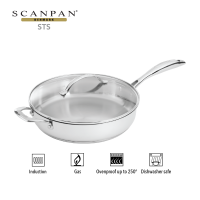
SCANPAN STS 28cm/4L Covered Sauté Pan
$109.00$239.00
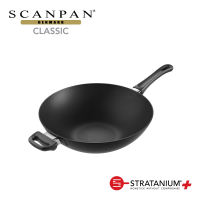
SCANPAN Classic 32cm/4.5L Wok
$189.00$409.00
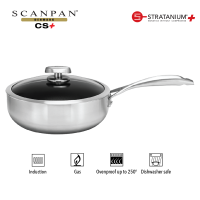
SCANPAN CS+ 26cm/3.7L Covered Deep Sauté Pan
$299.00$599.00
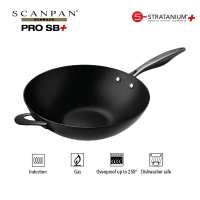
SCANPAN Pro SB+ 32cm Wok
$319.00$579.00
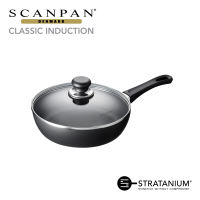
SCANPAN Classic Induction 24cm/2L Covered Sauté Pan
$179.00$409.00
About Scanpan
Scanpan is a Danish cookware manufacturer best known for its premium non-stick frying pans, saucepans, sauté pans, Dutch ovens and other kitchen equipment. Founded in 1956 in Ryomgård, Denmark, the company has built its reputation on Danish manufacturing, cast and recycled aluminium construction, proprietary non-stick technology, durability and functional Scandinavian design. In 2026, Scanpan marks its 70th anniversary.1
Company overview
| Item | Information |
|---|---|
| Brand | Scanpan |
| Company | SCANPAN A/S |
| Founded | 1956 |
| Country of origin | Denmark |
| Headquarters & main factory | Ryomgård, Denmark |
| Industry | Cookware & kitchenware |
| Best known for | Premium non-stick cookware |
| Core material | Recycled aluminium in cast-aluminium cookware |
| Signature technology | STRATANIUM® non-stick coating |
| Ownership | Danish-owned, family-run company |
| Markets | More than 50 countries |
| Major product families | Classic, Classic Induction, Professional, Pro IQ, CTX, HAPTIQ, TECHNIQ, CS+, ES5, Urban and others |
Scanpan exports to more than 50 countries, with exports accounting for over 75% of turnover, while maintaining its headquarters and primary factory near Aarhus, Denmark.2 The name Scanpan is a shortened form of “Scandinavian Pan”, reflecting the company’s Danish and Scandinavian heritage.3 Unlike many cookware brands that outsource production, Scanpan emphasises that its principal cast-aluminium cookware is manufactured in its own Danish facility.4
The brand identity is closely associated with Danish manufacturing, Scandinavian functionalism, simplicity, practicality, durability, food-focused design and responsible material use.
History
1956: Origins
Scanpan’s origins were somewhat accidental. Founder and inventor G.A. Thorsen was initially developing a pressure cooker; although the pressure-cooker project was abandoned, the lid developed for it became the basis for a frying pan. This resulted in what Scanpan describes as the world’s first pressure-cast frying pan, establishing the manufacturing approach that remains central to the company.5 Production began in Ryomgård, Denmark, where the company’s manufacturing heritage remains rooted today.
1976: Ryomgård factory
The current Scanpan factory in Ryomgård opened in 1976 and became the centre of the company’s casting, finishing, coating and quality-control operations.6 The manufacturing process combines traditional craftsmanship with modern technology. Molten recycled aluminium is cast into moulds and subjected to approximately 250 tonnes of pressure, a process Scanpan states contributes to the cookware’s strength and heat distribution.7
2002: Rebranding
The company changed its name from Pyrolux to Scanpan in 2002, helping to establish Scanpan as the international brand name associated with its Danish cookware.8
2017–2018: STRATANIUM technology
One of Scanpan’s most significant technological developments was STRATANIUM, its proprietary non-stick coating system introduced in 2017 after more than two years of research and testing. It uses multiple layers containing hard particles and wave-like structures designed to reinforce the non-stick surface.9 In 2018, Scanpan subsequently developed STRATANIUM+, a more commercially oriented version tested in restaurants for over two years before consumer release, designed particularly for demanding cooking and searing applications.10
2026: 70th anniversary
The year 2026 marks Scanpan’s 70th anniversary. The company is using this milestone to highlight its Danish manufacturing heritage and the Classic range, which it describes as its oldest and foundational cookware line.11
Manufacturing and materials
Production in Denmark
Scanpan states that its cast-aluminium non-stick cookware continues to be produced at its own factory in Ryomgård, Denmark.12 The manufacturing process involves melting recycled aluminium, casting, high-pressure forming, finishing, coating, inspection and packaging. The company describes this process as combining experienced human craftsmanship with modern technology, noting that many production employees have decades of experience with its manufacturing methods.13
It is important to note that not every Scanpan product is manufactured in Denmark. For example, Scanpan states that its cutlery is designed in Denmark but manufactured in China to its specifications, whereas its core cookware is made in Denmark.14 Therefore, while “Scanpan is a Danish brand” is accurate, the statement that every Scanpan product is made in Denmark would be incorrect.
Pressure casting
A key element of Scanpan’s identity is its cast-aluminium construction. Rather than stamping thin aluminium sheet, Scanpan uses a casting process in which molten aluminium is placed into a mould and compressed under approximately 250 tonnes of pressure.15 The intended advantages include stronger cookware bodies, good heat distribution, reduced risk of deformation, substantial pan construction, consistent geometry and long service life. This distinguishes Scanpan’s cookware from less expensive stamped non-stick pans.
Recycled aluminium
Sustainability is a major component of the Scanpan story. The company states it has used recycled aluminium since its beginnings, with its earliest cookware produced using recycled metal scraps dating back to the post-WWII period.16 Today, the aluminium used is sourced from recycled material, although the final alloy may contain a small proportion of virgin aluminium to meet technical specifications. Scanpan reports that its products average approximately 93–96% recycled metal, depending on the formulation.17
Recycling aluminium generally requires substantially less energy than producing aluminium from newly extracted raw materials. However, Scanpan acknowledges that sustainability is a complex issue rather than simply a marketing label, as manufacturing, coatings, transportation and end-of-life disposal all have environmental impacts.18
Non-stick technology
STRATANIUM®
STRATANIUM is the technology most strongly associated with modern Scanpan. It is described as a proprietary, PFOA/PFOS-free non-stick coating system constructed using multiple layers incorporating hard particles and textured structures.19 The objective is to provide non-stick performance, abrasion resistance, durability, ease of cleaning, metal-utensil safety and high cooking performance. Scanpan states its STRATANIUM system is designed to be metal-tool safe, though proper care remains important to maximise coating life.20
STRATANIUM vs STRATANIUM+
| Technology | Positioning | Examples |
|---|---|---|
| STRATANIUM | Flagship non-stick system | Classic, Classic Induction, Professional, Pro IQ, CTX |
| STRATANIUM+ | Commercial/pro-oriented textured non-stick | HAPTIQ, CS+, TECHNIQ |
STRATANIUM+ features a texture intended to support searing performance while retaining non-stick characteristics.
Safety and chemistry
Scanpan identifies STRATANIUM as PFOA/PFOS-free. However, PFOA-free does not mean the product contains no fluorinated chemistry whatsoever. In response to increasing interest in PFAS-free coatings, Scanpan promoted Stratanium Leap in 2026, which it describes as produced without PFAS. Consumers for whom chemical composition is a deciding factor should examine the specific collection and coating generation rather than treating all Scanpan products as chemically identical.
Product ranges
Scanpan’s collections differ in body construction, induction compatibility, handle design, exterior finish, coating, intended user, price and aesthetic design.
Classic
Classic is arguably the most iconic Scanpan range, using cast recycled aluminium and STRATANIUM non-stick surface. Intended as an everyday cookware range, it represents the traditional formula of Danish cast aluminium, non-stick coating and practical design.
Classic Induction
Classic Induction is an evolution of the Classic concept designed specifically for induction cooktops, addressing the fact that traditional aluminium is not magnetic and cannot directly operate on induction hobs.
Professional
The Professional line focuses on functional kitchen performance with an understated stainless-steel appearance, aimed at users who prioritise practical cooking over decorative styling.
Pro IQ
Pro IQ combines cast recycled aluminium with induction compatibility and Scanpan’s non-stick technology. Positioned above the basic Classic concept, it incorporates more professional-oriented design elements.
CTX
CTX uses a 5-ply stainless-steel construction with an aluminium core rather than a cast-aluminium body. Designed for all cooktops including induction, it offers a premium stainless-steel appearance while retaining Scanpan’s non-stick technology.
HAPTIQ
HAPTIQ is a higher-end collection using 5-ply stainless-steel construction and STRATANIUM+ coating. Positioned toward demanding home cooks and professional-style cooking, its polished stainless-steel exterior gives it a more luxurious appearance than Classic.
TECHNIQ
TECHNIQ is designed around professional cooking functionality and incorporates STRATANIUM+. Notably, Scanpan has experimented with the geometry and angles of the cookware rather than solely producing conventional round pans.
CS+
CS+ is a premium stainless-steel and non-stick construction using STRATANIUM+, situated toward the performance-oriented end of Scanpan’s catalogue.
Urban
The Urban collection focuses on flexibility and storage. Some Urban pans feature detachable handles, allowing versatile use and compact storage.
Construction philosophies
Scanpan’s range can be understood through two fundamental body constructions:
- Cast/squeeze-cast aluminium: Used by Classic, Classic Induction, Professional, Pro IQ, ES5 and TECHNIQ.
- Stainless-steel-clad construction: Used by CTX, CS+ and HAPTIQ.
This distinction is often more useful than memorising individual collection names.
Design philosophy
Scanpan’s aesthetic is broadly described as Danish functionalism, avoiding excessive decoration in favour of simple silhouettes, ergonomic handles, functional proportions, stainless-steel details, dark non-stick interiors, practical lids and long-term usability. This aligns with the broader Scandinavian design tradition of visual restraint and functional emphasis. The company describes its cookware as combining traditional Danish craftsmanship with modern technology and timeless functionality.
Target market and positioning
Scanpan occupies the premium cookware segment. Its customers include home cooks seeking better performance than entry-level non-stick pans, serious home chefs who value heat control, searing, durability and construction quality, and professional kitchens through its hospitality segment. The “Made in Denmark” provenance is also a significant part of the brand’s premium positioning.
In the broader cookware market, Scanpan sits above mass-market premium brands such as Tefal or Circulon, and below high-end specialist brands such as All-Clad, Demeyere, Mauviel or Staub. Its distinctive position is offering premium construction and professional-style performance while retaining the convenience of non-stick cooking.
Comparison with other materials
Versus stainless steel: Scanpan non-stick is best suited for eggs, fish, pancakes, delicate foods, low-to-medium-fat cooking and easy cleanup. Stainless steel remains superior for very high-heat cooking, browning, fond development, deglazing and long-term surface durability. Premium collections like HAPTIQ and CTX attempt to bridge this gap by combining stainless-steel construction with non-stick technology, but a non-stick pan is not a complete replacement for stainless steel or cast iron.
Versus cast iron: Scanpan differs fundamentally from cast iron. It is moderate to heavy rather than very heavy, features a built-in non-stick coating rather than seasoning-based release, is generally not prone to rust, easier to clean, and requires less maintenance. Cast iron offers superior heat retention and durability but requires seasoning and longer preheating. Scanpan is therefore oriented toward convenience and controlled performance.
Strengths and considerations
Strengths
- Genuine Danish manufacturing: Much of the core cookware is actually produced in Denmark, distinguishing it from brands that are merely Danish in origin.
- Non-stick expertise: Non-stick technology has been central to the business for decades.
- Recycled aluminium: The use of recycled aluminium is unusually central to the manufacturing philosophy.
- Heat performance: Cast construction provides substantially more thermal mass than thin budget non-stick cookware.
- Durability: Premium cookware is designed for long-term use rather than short replacement cycles.
- Brand heritage: “Made in Denmark since 1956” provides a clear identity lacking in generic manufacturers.
Considerations
- Price: Scanpan is considerably more expensive than mass-market non-stick cookware, reflecting Danish manufacturing, material quality, casting, coating technology and brand positioning.
- Weight: Cast aluminium and multi-layer stainless-steel cookware tend to be heavier than inexpensive stamped aluminium pans.
- Coating lifespan: Even durable non-stick coatings are not immortal; heat abuse, thermal shock, unsuitable cleaning and general wear can reduce performance over time.
- Maintenance: Although marketed as durable and dishwasher/metal-tool safe, careful use generally extends the life of non-stick cookware.
Warranty
Scanpan’s USA FAQ states that its cookware comes with a lifetime warranty against manufacturing defects. This is distinct from a guarantee that the non-stick surface will remain perfect indefinitely. Coverage typically excludes scratches, normal coating wear, overheating, improper use and cosmetic damage. Warranty terms vary by market, so buyers in Singapore should verify the specific terms applicable locally.
Sustainability philosophy
Scanpan claims its focus on waste reduction and recycled aluminium dates back to 1956, meaning the company used recycled materials decades before sustainability became a major consumer trend. Its philosophy centres on making cookware durable enough that consumers do not need to replace it frequently—a relevant concept given that inexpensive non-stick pans are often treated as disposable. The sustainability strategy combines recycled aluminium, long product life, Danish manufacturing, waste reduction, manufacturing controls and ongoing coating development.
Global presence
Although strongly Danish in identity, Scanpan is an international business exporting to more than 50 countries. It operates subsidiaries in the United States, Norway, Singapore and China, while its headquarters and main factory remain in Denmark. The company has maintained a strong “Made in Denmark” identity despite competing in an industry dominated by international manufacturing.
Summary
Scanpan is one of Denmark’s notable premium cookware manufacturers with a particularly strong position in the premium non-stick category. Its history dates to 1956, its core cookware remains manufactured in Denmark, and its identity revolves around cast aluminium, recycled materials, Danish craftsmanship and proprietary non-stick technology. Its most important technological name is STRATANIUM, while its portfolio ranges from the straightforward Classic series to sophisticated stainless-steel constructions such as CTX, CS+ and HAPTIQ. As of 2026, Scanpan is celebrating 70 years in business, marking it as an established cookware manufacturer rather than a recent entrant to the premium kitchenware market.
References
- About Us: The Scanpan Story | Scanpan USA
- SCANPAN 70th Anniversary | Celebrating Danish Cookware Excellence Since 1956 | Scanpan USA
- SCANPAN – Made in Denmark
- SCANPAN Nonstick Cookware FAQs| Frequently Asked Questions About SCANPAN Nonstick Cookware at SCANPAN USA | Scanpan USA
- 70th anniversary – Scanpan
- Recycled Aluminum – Scanpan USA | Scanpan USA
- Sustainability | Scanpan USA
- Ranges Made in Denmark
- Hospitality | Scanpan USA
- Not All Chemicals Are Created Equal: The Truth About PTFE in Scanpan Cookware | Scanpan USA
- Scanpan – FAQs | Scanpan USA
- Nonstick Cookware | Shop Online for Safe Nonstick Cookware. The Best Nonstick Cookware Brand Made in Denmark | Scanpan USA
- Consumer Right to Know Disclosure | Scanpan USA
- Environmentally-Progressive Cookware | Scanpan USA
- BLOG | Scanpan USA
- About Scanpan | Danish Heritage & Professional Cookware Since 1956
- SCANPAN cookware collections – made in Denmark
- SCANPAN’s coating
- SCANPAN 70 Year Anniversary Collection | SCANPAN UK
- SCANPAN 70 Year Anniversary Collection | SCANPAN UK