Shop on Lazada
Swatch products
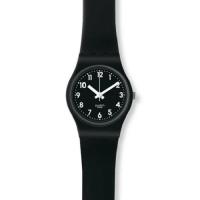
Swatch Lady Black Single (LB170E) 25mm Quartz Black Silicone Strap Watch
$84.00
Buy on Lazada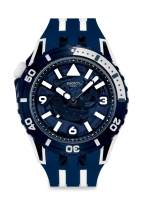
Swatch Sea Wasp (SSCU09N100) Blue 44mm Silicone Watch
$213.00
Buy on Lazada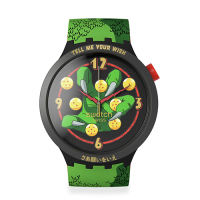
Shenron X Swatch (SB01Z102) Black Quartz 47mm Silicone Strap Watch
$197.00
Buy on Lazada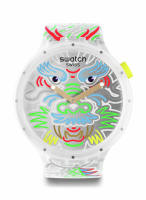
Swatch Dragon In Cloud (SB05Z102) Transparent 47mm Silicone Strap Watch
$182.00
Buy on Lazada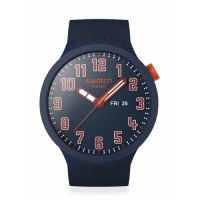
Swatch Essentially Confident (SB01S700) Blue 47mm Silicone Watch
$175.00
Buy on Lazada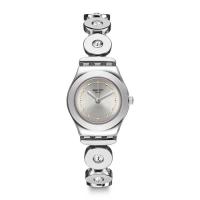
Swatch Inspirance (YSS317G) Watch
$182.00
Buy on Lazada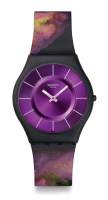
Swatch Paradise Bloom (SS08B106) Black 34mm Silicone Watch
$167.00
Buy on Lazada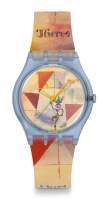
Swatch Klees Bavarian Don Giovanni (SO28Z703) Yellow 34mm Silicone Watch
$137.00
Buy on LazadaAbout Swatch
Overview
Swatch is a Swiss watch brand established in 1983 and headquartered in Biel/Bienne, Switzerland. It is owned by The Swatch Group, one of the world’s largest watchmaking conglomerates. The brand gained international prominence by combining Swiss watchmaking, inexpensive mass production, colourful design, pop culture and aggressive marketing into a product positioned as an everyday fashion accessory rather than a traditional luxury timepiece.1
Today, Swatch remains one of the most recognisable Swiss watch brands globally. It is particularly associated with its colourful plastic watches, artistic collaborations, the SISTEM51 automatic movement, BIOCERAMIC material technology, and high-profile partnerships such as OMEGA × Swatch MoonSwatch and Blancpain × Swatch.
| Attribute | Information |
|---|---|
| Brand | Swatch |
| Full company name | Swatch Ltd. |
| Founded | 1983 |
| Place founded | Switzerland |
| Headquarters | Biel/Bienne, Switzerland |
| Industry | Watchmaking / fashion |
| Parent company | The Swatch Group Ltd. |
| Founder / key figure | Nicolas G. Hayek |
| Original concept | Affordable, high-tech Swiss “second watch” |
| Country of origin | Switzerland |
| Products | Watches, watch accessories and related products |
| Signature characteristics | Colourful designs, Swiss Made production, quartz, mechanical and innovative materials |
| Major movements/materials | Quartz, SISTEM51, BIOCERAMIC |
| Notable collaborations | OMEGA, Blancpain, artists, designers and cultural institutions |
The Swatch Group identifies 1983 as the birth of the first Swatch, describing the original concept as a low-cost, high-tech, artistic and emotional Swiss Made “second watch”.2
Origins
Swatch emerged during one of the most challenging periods in the history of the Swiss watch industry. Throughout the 1970s and early 1980s, traditional Swiss manufacturers faced intense competition from inexpensive electronic and quartz watches, particularly from Asian producers. Quartz technology enabled cheap, accurate and large-scale production, while much of the Swiss sector remained heavily oriented towards mechanical watchmaking. This downturn became known as the Quartz Crisis.3
Two major Swiss watch-industry organisations were severely affected:
- ASUAG: A major Swiss movement and component manufacturer founded in 1931.
- SSIH: A major Swiss watch group formed in 1930, whose portfolio included Omega and Tissot.
Both entities eventually encountered severe financial difficulties. Swiss banks engaged consultant Nicolas G. Hayek to analyse the situation and develop a rescue strategy.4
Hayek’s proposal was not simply to manufacture another traditional Swiss watch. Instead, he advocated combining:
- Inexpensive production
- Modern quartz technology
- Swiss manufacturing
- Attractive industrial design
- Strong branding
- Emotional marketing
- Radically simplified construction
The result of this strategy was Swatch.5
The “Swatch” Concept
The name Swatch is widely understood to be a contraction of “second watch”. The underlying idea was that consumers would not necessarily purchase a Swatch as their sole or most prestigious timepiece. Rather, it was intended to be an inexpensive, fun second watch that could be changed according to clothing, mood or occasion.
This represented a significant conceptual shift. Traditional Swiss watches were typically marketed around precision, craftsmanship, heritage, durability and prestige. Swatch introduced an alternative formula centred on timekeeping, fashion, colour, personality and collectibility. The Swatch Group itself describes the original product as a “low-cost, high-tech, artistic and emotional” Swiss Made watch.6 This philosophy became central to the brand’s identity.
The First Swatch
The first Swatch launched in 1983. One of its most critical innovations was its extremely simplified construction. The original model used only 51 components, compared to the significantly higher number traditionally associated with mechanical watches. Production was highly automated, which helped keep costs low while retaining Swiss manufacturing standards.7
The first generation featured:
- Quartz technology
- A plastic case
- Relatively few components
- Automated production
- Colourful and unconventional designs
- Swiss-made movements
This combination allowed Swatch to offer a Swiss-made watch at a price point far below many traditional Swiss counterparts. Consequently, the first Swatch was not merely a new model but represented a new manufacturing and marketing philosophy for Swiss watchmaking.
Role of Nicolas G. Hayek
A central figure in the Swatch narrative is Nicolas G. Hayek (1928–2010). A Lebanese-Swiss entrepreneur and consultant, Hayek played a crucial role in restructuring the troubled Swiss watch industry. His strategy involved merging ASUAG and SSIH to create a new organisation capable of competing with the rapidly growing Asian quartz-watch sector.
The companies were consolidated into SMH — Société Suisse de Microélectronique et d’Horlogerie. Hayek subsequently became a central executive figure within the organisation. In 1998, SMH was renamed The Swatch Group Ltd.8
Hayek did not personally invent every technical element of the Swatch watch; development involved various Swiss watchmaking engineers and organisations. His primary contribution was the business strategy and industrial vision that transformed the technology into a globally successful consumer brand. The Swatch Group credits Hayek’s strategy and the 1983 launch of Swatch with helping drive the recovery of the Swiss watch industry.9
Revival of Swiss Watchmaking
Swatch’s significance extends beyond its own sales figures. The brand demonstrated that Swiss watchmaking could adapt to quartz technology rather than simply resist it. Instead of competing directly with inexpensive Japanese quartz watches using traditional methods, Swatch embraced quartz, automation, plastic, design, Swiss identity and marketing. This helped establish a new mass-market category for Swiss watches.
Simultaneously, the restructuring surrounding Swatch helped preserve and consolidate important Swiss watchmaking companies and technologies. The resulting corporate entity eventually became The Swatch Group, which today owns a diverse portfolio spanning entry-level, premium, luxury and high-end watch brands.10
Swatch as a Fashion Brand
One of Swatch’s most significant innovations was treating the watch as a fashion object. Rather than presenting the timepiece merely as a functional instrument, Swatch integrated it into personal style. This approach led to the use of bright colours, unusual graphics, artist collaborations, limited editions, seasonal designs, pop-culture partnerships and collectible models.
The result was a product that could remain inexpensive while feeling culturally significant. Swatch therefore occupies a unique position at the intersection of watchmaking, fashion, design, art and popular culture.
Art and Cultural Collaborations
Swatch became particularly renowned for collaborations with artists and cultural institutions. The brand has produced watches incorporating artwork and design influences from numerous creatives and projects. Its Art Journey programme, for example, translates famous artworks into wearable watch designs.11
This approach reinforces a core Swatch tenet: a watch does not have to be visually conservative simply because it is Swiss. The watch face serves as a small canvas. This strategy also fostered a significant collecting culture, with enthusiasts seeking specific designs, special editions and collaborative releases.
Major Product Categories
Swatch’s catalogue has expanded considerably since 1983 to include several distinct families.
GENT
The classic Swatch form factor, traditionally associated with a 34 mm case.
NEW GENT
A larger interpretation of the classic Swatch, measuring approximately 41 mm.
LADY
A smaller format, traditionally around 25 mm.
SKIN
Swatch’s thin and minimalist watch family.
IRONY
Models featuring metal construction, including aluminium and stainless steel.
CHRONO
Quartz chronograph watches designed with a sporty aesthetic.
BIG BOLD
Large-format watches characterised by oversized cases and highly visible designs. Swatch currently describes BIG BOLD models as having a 47 mm diameter.12
SISTEM51
Swatch’s distinctive automatic mechanical platform.
BIOCERAMIC
A proprietary material platform combining ceramic with a biosourced component.
These categories demonstrate how Swatch has evolved from a single concept into a comprehensive watch family.13
SISTEM51
One of Swatch’s most important technical developments following its original quartz movement was SISTEM51, introduced in 2013. The name deliberately references the original Swatch concept, as the movement contains exactly 51 components. However, unlike the original quartz models, SISTEM51 is a self-winding mechanical movement.
According to Swatch, the movement consists of 51 parts arranged into five modules and uses a single central screw for the oscillating weight. Production is fully automated. The movement offers a stated 90-hour power reserve and features a Nivachron hairspring for magnetic resistance.14
SISTEM51 is significant because mechanical watches are traditionally associated with manual assembly and skilled labour. Swatch effectively asked whether mechanical watchmaking could be industrialised in the same radical manner as the original quartz Swatch. SISTEM51 was the affirmative answer.
BIOCERAMIC
Another major innovation is BIOCERAMIC. Swatch describes this composite material as consisting of approximately two-thirds ceramic powder and one-third biosourced material derived from castor oil. It is engineered to combine lightness, durability and a distinctive smooth, matte texture.15
BIOCERAMIC became particularly important as it provided Swatch with a new material platform for creating unusual shapes and colours. It also serves as the foundation for several of the company’s most internationally recognisable recent products.
MoonSwatch
Arguably the most culturally significant Swatch product of the 2020s is the Bioceramic MoonSwatch. In 2022, Swatch collaborated with sister brand OMEGA to reinterpret the famous Speedmaster Moonwatch. The resulting MoonSwatch utilised Swatch’s BIOCERAMIC material and manufacturing philosophy rather than conventional luxury production methods.
The original collection comprised 11 models, each inspired by a planetary body in the Solar System.16 The concept was highly unusual, combining OMEGA heritage, Swatch design philosophy, BIOCERAMIC and mass-market accessibility. It introduced one of the world’s most famous luxury chronograph designs to a much broader audience. The MoonSwatch subsequently became a major cultural and commercial phenomenon, generating considerable interest in both brands.
Blancpain × Swatch
Swatch later applied a similar strategy to another historic Swiss watchmaker, Blancpain. The Bioceramic Scuba Fifty Fathoms collection was created in collaboration with Blancpain, drawing inspiration from Blancpain’s landmark Fifty Fathoms diving watch design.
The collection uses BIOCERAMIC and, notably, SISTEM51 mechanical movements.17 This collaboration demonstrated that the Swatch concept was not limited to OMEGA but could serve as a broader strategy: taking historic Swiss watchmaking icons, reinterpreting them through Swatch, and introducing them to a wider audience.
Design Philosophy
Swatch’s design philosophy is defined by several key characteristics.
Colour
Colour is arguably Swatch’s most recognisable visual feature. Rather than restricting palettes to black, silver, white and gold, the brand frequently employs bright and unconventional combinations.
Playfulness
Swatch generally avoids excessive seriousness. Its watches often incorporate humour, unusual proportions, graphic patterns and unexpected references.
Accessibility
The brand has historically positioned itself considerably below traditional luxury-watch pricing tiers.
Collectibility
Because models change frequently, customers can treat Swatches as collectible objects.
Collaboration
Swatch regularly partners with artists, designers, cultural institutions and other watch brands.
Swiss Identity
Despite its unconventional appearance, Swatch maintains a strong connection to Swiss manufacturing. The brand states that its watches are Swiss Made.18
Business Structure
It is important to distinguish between Swatch and The Swatch Group. Swatch is a specific watch brand and company. The Swatch Group Ltd. is the larger Swiss watchmaking conglomerate that owns Swatch alongside numerous other brands. The group’s portfolio spans market segments ranging from Swatch to high-end names such as Breguet, Blancpain and Omega.
The corporate group originated from the restructuring and merger of ASUAG and SSIH, officially adopting the name The Swatch Group Ltd. in 1998.19
Relationship with OMEGA
The relationship between Swatch and OMEGA is notable because the brands sit at opposite ends of the traditional watch-market spectrum. OMEGA represents Swiss luxury watchmaking, technical history and prestige, while Swatch represents accessibility, experimentation, colour and pop culture.
The MoonSwatch effectively bridges these two worlds. This synergy is possible because both brands belong to the same corporate group, allowing The Swatch Group to use collaboration as a strategic tool to connect different segments of its portfolio.
Marketing Strategy
Swatch’s marketing has historically been almost as important as its engineering. Instead of relying primarily on traditional luxury advertising, the brand has utilised celebrity and artist collaborations, cultural events, limited editions, unusual advertising campaigns, vibrant retail environments, collectible designs and social-media-friendly products.
This approach makes Swatch particularly effective at generating conversation and cultural relevance. The MoonSwatch exemplifies this modern strategy: it was presented not merely as another quartz watch, but as an unexpected collaboration between two distinct Swiss brands.
Collecting Culture
Swatch maintains a strong relationship with watch collectors. The relatively accessible price point of many models means that collecting Swatches is considerably less financially demanding than collecting traditional high-end Swiss watches. Enthusiasts may focus on early 1980s models, rare colourways, artist editions, special collaborations, limited editions, unusual packaging, historical models or discontinued references.
The brand’s enormous variety enhances its appeal. Collectors are often attracted to owning a specific design with cultural or historical significance rather than seeking the “best” specimen in a traditional sense.
Cultural Significance
Swatch’s importance to horology exceeds its technical specifications. Prior to Swatch, the concept of a Swiss watch was strongly linked to precision, craftsmanship, mechanical movements and prestige. Swatch demonstrated that a Swiss watch could also signify plastic, quartz, colour, humour, fashion, art and mass production.
This shift was profoundly influential, helping to redefine the wristwatch as simultaneously a timekeeping device, fashion accessory, piece of graphic design, collectible, cultural statement and affordable consumer product.
Timeline
| Year | Event |
|---|---|
| 1930 | SSIH is formed |
| 1931 | ASUAG is founded |
| Late 1970s | Swiss watch industry enters severe crisis |
| 1980s | Nicolas G. Hayek develops restructuring strategy |
| 1983 | First Swatch is launched |
| 1985 | Swatch Ltd. is established within SMH |
| 1986 | Hayek becomes central leader of the newly consolidated group |
| 1987 | Flik Flak children’s watch introduced |
| 1992 | Nick Hayek joins Swatch |
| 1998 | SMH becomes The Swatch Group Ltd. |
| 2013 | SISTEM51 introduced |
| 2022 | OMEGA × Swatch MoonSwatch launched |
| 2023 | Blancpain × Swatch Bioceramic Scuba Fifty Fathoms launched |
| 2020s | BIOCERAMIC, collaborations and new collections become central to Swatch’s identity |
The Swatch Group’s official history confirms these major milestones, including the 1983 Swatch launch, the 1985 creation of Swatch Ltd., the 1998 renaming of SMH to Swatch Group, and the 2013 introduction of SISTEM51.20
Swatch Today
As of 2026, Swatch continues to operate as a major consumer-facing brand within The Swatch Group. Its current product universe encompasses traditional Swatch designs alongside BIOCERAMIC watches, SISTEM51 mechanical watches, BIG BOLD, SKIN, IRONY, CHRONO, artistic collaborations, MoonSwatch, Scuba Fifty Fathoms, customised Swatch X You watches and newer thematic collections.21
The brand continues to emphasise experimentation over conventional luxury positioning. The Swatch Group’s latest investor materials, including a 2026 half-year report, indicate that the parent group remains an active publicly reporting Swiss watchmaking entity.22
Key Differentiators
Swatch’s identity can be distilled into several core concepts:
- Swiss Made: Retains Swiss manufacturing and watchmaking heritage.
- Affordable: Historically challenged the notion that Swiss watches must be expensive.
- Industrial: Automation and simplified construction are fundamental to the brand’s DNA.
- Artistic: Functions as a small piece of wearable design.
- Colourful: Colour remains one of its most recognisable characteristics.
- Playful: Treats watchmaking as enjoyable rather than excessively serious.
- Innovative: Technological experimentation, from the original 51-component quartz watch to SISTEM51 and BIOCERAMIC, is central.
- Collaborative: Partnerships with OMEGA, Blancpain, artists and cultural institutions define its modern identity.
Overall Significance
Swatch is more than a manufacturer of inexpensive plastic watches. Its historical importance lies in helping to change the direction of Swiss watchmaking during the Quartz Crisis. Its formula was simple yet revolutionary: make Swiss watches cheaper, simplify their construction, automate production, make them visually exciting, and market them as objects of fashion and culture. This approach helped create one of the world’s most recognisable watch brands and contributed to the restructuring and revival of the Swiss watch industry.23
In the 21st century, Swatch has extended this philosophy to mechanical movements, new materials and high-profile collaborations. SISTEM51 demonstrates its approach to mechanical watchmaking, while the BIOCERAMIC MoonSwatch illustrates its ability to merge mass-market design with high-end Swiss watch heritage.24
Swatch is a Swiss watch brand founded in 1983 that helped revive Swiss watchmaking by turning the traditional Swiss watch into an affordable, colourful, technologically innovative and highly marketable fashion object—and it continues to push that philosophy through products such as SISTEM51, BIOCERAMIC and MoonSwatch.25
References
- Swatch Group History – Swatch Group
- Swatch
- The Founder – Swatch Group
- Explore Swatch collections | Swatch® International
- Collections | Swatch® Online Store
- Swatch Sistem51 automatic watches | Swatch® USA
- Bioceramic: a watchmaking game-changer | Swatch® USA
- OMEGA X Swatch – Bioceramic MoonSwatch Collection | Swatch® official site
- Swatch Group Financial Reports – Swatch Group
- Swatch : Annual Report 2025Download PDF (5.53 MB) | MarketScreener Canada
- Key Figures 2025 – Swatch Group
- The man behind the Swatch
- L’homme derrière la Swatch
- Key Figures 2024 – Swatch Group
- manuals.plus
- Swatch Group Annual Report 2012
- The comeback of the Swiss watch industry on the world market: a business history of the Swatch Group (1983-2010) Munich Personal RePEc Archive
- Histoire de Swatch Group – Swatch Group
- Swatch Group Publications – Swatch Group
- Previous Annual and Half-Year Reports – Swatch Group
- Annual Report and Sustainability Report 2025 – Swatch Group
- Geschichte der Swatch Group – Swatch Group
- Storia di Swatch Group – Swatch Group
- Le Fondateur – Swatch Group
- Il Fondatore – Swatch Group